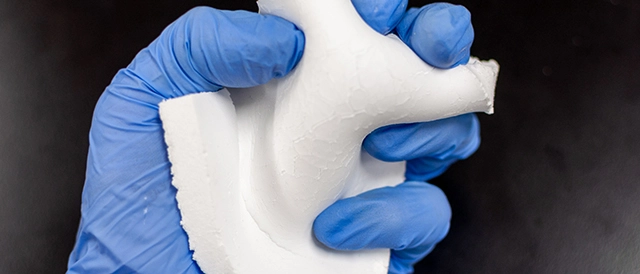
Marshmallow gel (MG) is a family of monolithic macroporous silicone materials obtained primarily by copolymerizing trifunctional and difunctional silicon alkoxides. Developed by Gen Hayase, these materials have a skeleton several micrometers thick and pores several tens of micrometers in diameter. Their properties include marshmallow-like flexibility, liquid repellency, liquid retention, and light scattering.
I am investigating applications as simple research tools and functional materials, including DIY dry shippers, giant vesicle (liposome) preparation, oil–water separation, optical tactile sensors, and diffuse reflectors.
About marshmallow gel
Marshmallow gel is a flexible macroporous material with a silicone skeleton. Whereas conventional silica gels and many inorganic porous materials are hard and brittle, marshmallow gel deforms under compression or bending and recovers its shape after the load is removed.
This flexibility arises from the flexible silicone molecular framework and the continuous porous structure on the micrometer scale. Both the skeleton and the void-rich structure accommodate deformation, allowing the lightweight material to withstand compression and bending.
Structure and characteristics
Marshmallow gel has a skeleton approximately several micrometers thick and pores approximately several tens of micrometers in diameter. This macroporous structure permits liquid absorption and retention, compressive deformation, and multiple scattering of light within the material.
The standard composition is hydrophobic and oleophilic. It resists wetting by water but readily absorbs oil, allowing selective oil uptake from water. Chemical modification of the surface can further control water and oil repellency.
Preparation of marshmallow gel
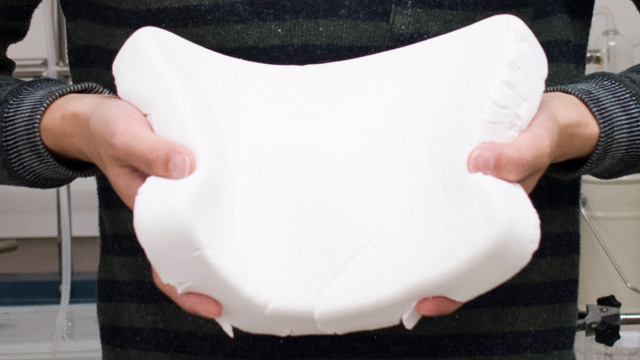
Marshmallow gel is obtained by a sol–gel reaction. The preparation is reproducible and has been used in high-school and university teaching. The basic procedure is given below. Alternatives include room-temperature preparation using aqueous ammonia instead of urea, and surfactant-free aqueous preparation by copolymerization with tetramethoxysilane. Minor updates have accompanied successive publications.
Preparation example
Reagents
- 5 mM aqueous acetic acid: 1500 mL
- Urea: 500 g
- n-Hexadecyltrimethylammonium chloride (CTAC): 100 g
- Methyltrimethoxysilane (MTMS): 300 mL
- Dimethyldimethoxysilane (DMDMS): 200 mL
Procedure
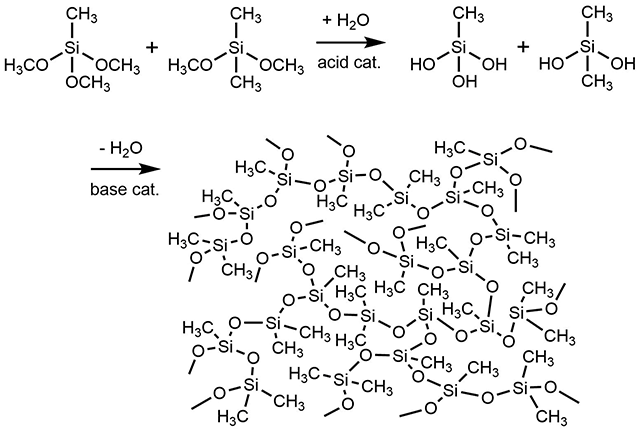
- Dissolve MTMS, DMDMS, urea, and the surfactant CTAC in aqueous acetic acid and stir for 30 minutes. Hydrolysis of the alkoxides proceeds during this step. MTMS is trifunctional; DMDMS is difunctional.
- Transfer the reaction mixture to a sealed container and allow gelation and aging at 80 °C for approximately 6 hours.
- Wash the resulting gel by immersion in water and alcohol.
- Dry by evaporation.
Properties of marshmallow gel
Mechanical properties
Marshmallow gel deforms flexibly under compression and bending and rapidly recovers its shape after unloading. This behavior arises from its flexible molecular framework and micrometer-scale microstructure.
Low-temperature behavior and thermal insulation
The mechanical properties of MTMS–DMDMS marshmallow gel change little between −130 and 320 °C. [2] Some flexibility remains even below the glass-transition temperature, including in liquid nitrogen.
The thermal conductivity is approximately 30 mW m⁻¹ K⁻¹ near room temperature. A vacuum flask filled with marshmallow gel and impregnated with liquid nitrogen can serve as a simple dry shipper for transporting cryopreserved embryos. [6]
Sound absorption and vibration damping
The flexible skeleton and abundant pores provide sound absorption and vibration damping. These properties suggest applications for suppressing sound and vibration using a lightweight, flexible porous material. [1]
Hydrophobicity
Marshmallow gel has hydrophobicity comparable to that of PDMS. Its bulk surface is water-repellent, and can be superhydrophobic, without a separate surface treatment. This behavior arises from surface roughness and the intrinsic hydrophobicity of the molecular framework. The standard composition is hydrophobic and oleophilic, allowing it to absorb oil selectively from water like a sponge. [2]
Applications of marshmallow gel
Oil–water separation
The standard composition repels water and absorbs oil. Oil present on the water surface or within water can therefore be collected in the gel. Its flexibility and availability as a large monolith suggest applications in oil recovery and analytical chemistry as well as laboratory-scale separation. [2]
Liquid-nitrogen retention and simple dry shippers
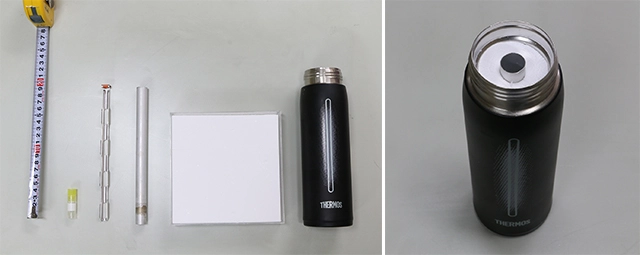
Marshmallow gel can absorb and retain liquid nitrogen. Filling a vacuum flask with the gel and impregnating it with liquid nitrogen provides a simple container for cryopreserved embryos. Retention within the porous material reduces liquid-nitrogen spillage. [6]
Giant-vesicle preparation
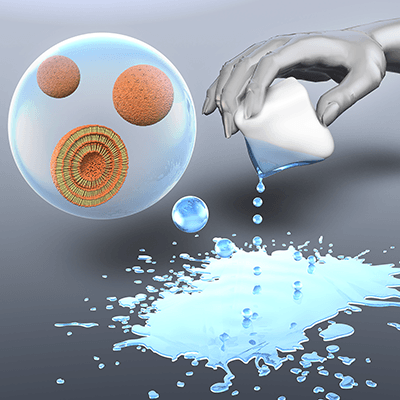
A marshmallow gel is impregnated with a phospholipid solution and dried. Wetting the lipid-coated gel with buffer and squeezing it produces a giant-vesicle (liposome) dispersion simply and in large quantities. Lipid retention within the pores followed by wetting and squeezing provides vesicles for artificial-cell and membrane-model studies. [7]
Combining the gel with a mesh provides an easy-to-handle sheet. Mechanical reinforcement extends its range of applications. [9]
Capsules and liquid marbles
Liquid-repellent marshmallow gels and gel fragments can be used to prepare droplets and capsules. Superoleophobic surfaces serve as substrates for capsule formation in air. Gel fragments can also form the shell of liquid marbles and capsules. [4–5,10]
Water- and oil-repellent materials
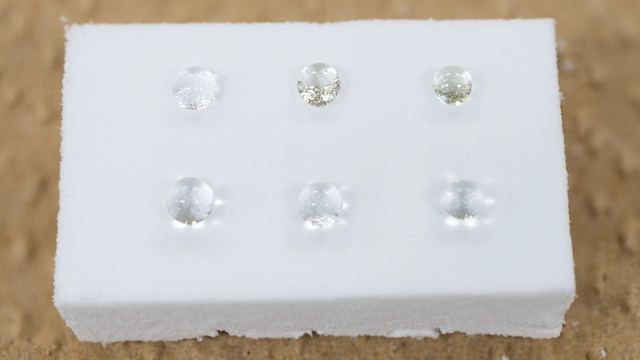
VTMS–VMDMS marshmallow gels have numerous vinyl groups on their surfaces, enabling chemical modification, for example by thiol–ene reactions. Modification with perfluoroalkyl groups can control liquid repellency. Cut surfaces of modified gels are superoleophobic to liquids including n-hexadecane, providing gels that repel both water and oil. [3]
Optical applications
Marshmallow gel appears white because its micrometer-scale skeleton scatters light by Mie scattering. Compression brings the skeleton elements closer together, promotes multiple scattering, and decreases the backscattered intensity. I developed a simple optical tactile sensor that detects the change in light intensity using a photoreflector. [13]
A marshmallow gel with an optimized structure has a diffuse reflectance of approximately 98%. I am investigating applications as diffuse-reflectance standards and solar-reflective materials. [14]
Publications
- Hayase, G.; Kanamori, K.; Nakanishi, K. New flexible aerogels and xerogels derived from methyltrimethoxysilane/dimethyldimethoxysilane co-precursors, J. Mater. Chem. 2011, 21, 17077-17079.
doi:10.1039/C1JM13664J (Accepted manuscript)
Preparation and basic properties of MG - Hayase, G.; Kanamori, K.; Fukuchi, M.; Kaji, H.; Nakanishi, K. Facile Synthesis of Marshmallow-like Macroporous Gels Usable under Harsh Conditions for the Separation of Oil and Water, Angew. Chem., Int. Ed. 2013, 52, 1986-1989.
doi:10.1002/anie.201207969 (Accepted manuscript)
MG for oil–water separation and flexibility in liquid nitrogen - Hayase, G.; Kanamori, K.; Hasegawa, G.; Maeno, A.; Kaji, H.; Nakanishi, K. A Superamphiphobic Macroporous Silicone Monolith with Marshmallow-like Flexibility, Angew. Chem., Int. Ed. 2013, 52, 10788–10791.
doi:10.1002/anie.201304169 (Accepted manuscript)
Superoleophobic MG through surface modification - Takei, T.; Terazono, K.; Araki, K.; Ozuno, Y.; Hayase, G. Kanamori, K.; Nakanishi, K.; Yoshida, M. Encapsulation of hydrophobic ingredients in hard resin capsules with ultrahigh efficiency using a superoleophobic material, Polym. Bull. 2016, 73, 409-417.
doi:10.1007/s00289-015-1497-y
Capsule formation in air using MG as a liquid-repellent substrate - Takei, T.; Araki, K.; Terazono, K.; Ozuno, Y.; Hayase, G.; Kanamori, K.; Nakanishi, K.; Yoshida, M. Highly Efficient Encapsulation of Ingredients in Poly(methyl methacrylate) Capsules Using a Superoleophobic Material, Polym. Polym. Compos. 2017, 25, 129-134.
doi:10.1177/096739111702500202
Capsule formation in air using MG as a liquid-repellent substrate - Hayase, G.; Ohya, Y. Marshmallow-like silicone gels as flexible thermal insulators and liquid nitrogen retention materials and their application in containers for cryopreserved embryos, Appl. Mater. Today 2017, 9, 560-565.
doi:10.1016/j.apmt.2017.10.004 (Accepted manuscript)
Simple dry shipper for cryopreserved mouse embryos using MG to retain liquid nitrogen - Hayase, G.; Nomura, S. M. Large-Scale Preparation of Giant Vesicles by Squeezing a Lipid-Coated Marshmallow-Like Silicone Gel in a Buffer, Langmuir 2018, 34, 11021-11026. doi:10.1021/acs.langmuir.8b01801 (Accepted manuscript・ACS Articles on Request)
Giant-vesicle preparation by squeezing lipid-coated MG - Takei, T.; Yamasaki, Y.; Yuji, Y.; Sakoguchi, S.; Ozuno, Y.; Hayase, G.; Yoshida, M. Millimeter-sized capsules prepared using liquid marbles: encapsulation of ingredients with high efficiency and preparation of spherical core-shell capsules with highly uniform shell thickness using centrifugal force, J. Colloid Interf. Sci. 2019, 536, 414-423.
doi:10.1016/j.jcis.2018.10.058
Liquid marbles and capsules with shells made from MG fragments - Hayase, G.; Nomura, S. M. Macroporous Silicone Sheets Integrated with Meshes for Various Applications, ACS Appl. Polym. Mater. 2019, 1, 2077-2082.
doi:10.1021/acsapm.9b00382 (Accepted manuscript・ACS Articles on Request)
Applications of mesh-reinforced MG sheets - Sreejith, K. R.; Gorgannezhad, L.; Jin, J.; Ooi, C. H.; Takei, T.; Hayase, G.; Stratton, H.; Lamb, K.; Shiddiky, M.; Dao, D. V.; Nguyen, N. Core-Shell Beads Made by Composite Liquid Marble Technology as A Versatile Microreactor for Polymerase Chain Reaction, Micromachines 2020, 11, 242.
doi:10.3390/mi11030242(Open access)
PCR within MG liquid marbles and capsules - Hayase, G. Surfactant-free Aqueous Fabrication of Macroporous Silicone Monoliths for Flexible Thermal Insulation, Bull. Chem. Soc. Jpn. 2021, 94, 2210-2215.
doi:10.1246/bcsj.20210189 (Accepted manuscript)
Surfactant-free preparation in a simple aqueous system - Nomura, S. M.; Shimizu, R.; Archer, R. J.; Hayase, G.; Toyota, T.; Mayne, R.; Adamatzky, A. Spontaneous and driven growth of multicellular lipid compartments to millimeter size from porous polymer structures. ChemSystemsChem 2022, 4, e202200006. doi:10.1002/syst.202200006 (Open access)
Artificial cells growing from MG - Hayase, G. Optical Tactile Sensor Using Scattering inside Sol-Gel-Derived Flexible Macroporous Monoliths. Sens. Actuator A Phys. 2023, 354, 114253. doi:10.1016/j.sna.2023.114253 (ChemRxiv)
Tactile sensing using light scattering inside MG - Hayase, G. Marshmallow-like Macroporous Silicone Monoliths as Reflective Standards and High Solar-Reflective Materials. ACS Appl. Polym. Mater. 2023, 5, 5280–5285. doi:10.1021/acsapm.3c00695 (Accepted manuscript・ACS Articles on Request)
Diffuse-reflectance materials using MG